

Hospital Modesty: Eh, They’ve Seen It All Before

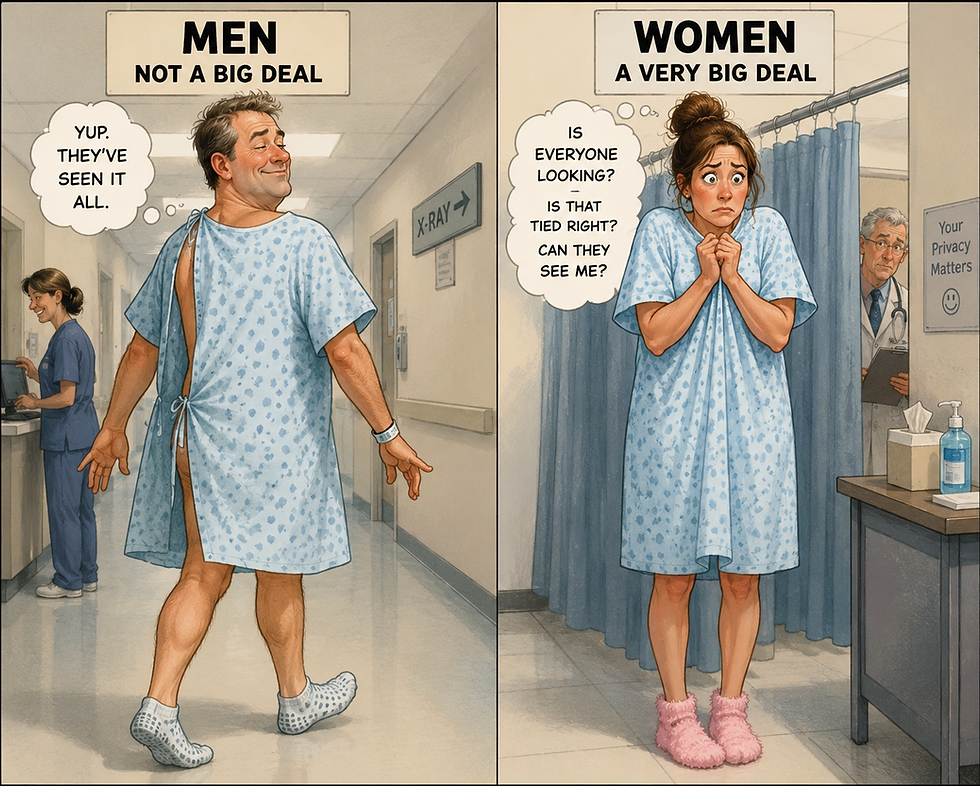
The moment a person changes from regular clothes into a hospital gown, dignity officially becomes a negotiable concept. One minute, you are a functioning adult with opinions and personal boundaries. The next minute, you are wearing what appears to be an open-backed napkin secured by two strings and a prayer. Yet even in this deeply vulnerable state, men and women often react in hilariously different ways when it comes to modesty in the hospital.
Women tend to enter the hospital already emotionally preparing for humiliation. Before a single procedure has even begun, a woman is quietly calculating exactly how much of her body is about to become public property. She asks questions like, “Will I need to remove my bra?” “Will people be coming in and out?” and “Is this gown tied correctly?” Meanwhile, five different medical professionals have already seen her shoulder, knee, and possibly one entire side of her body while she was trying to preserve “privacy” with a six-inch blanket.
Men, on the other hand, often begin with tremendous confidence. A man walking into a hospital room may casually announce, “Eh, they’ve seen it all before.” This fearless attitude usually lasts right up until the moment a nurse says, “Sir, we’re going to insert the catheter now. A man is more interested in ending whatever pain they are in than worrying about who sees his private parts.
Women also tend to assume that every exposed body part is being silently evaluated. If a female patient has surgery at 7 a.m., there is a good chance she spent the night before apologizing internally for not moisturizing her legs. Somewhere in her mind, she believes a surgical team of twelve people may pause mid-operation to discuss her dry elbows or the extra pounds that she put on during the winter. Logic does not matter. Hospital vulnerability awakens insecurities that women forgot they even had.
Men experience an entirely different psychological crisis. Their concern is less about appearance and more about territory. A woman may worry about being seen. A man worries about losing control of the situation entirely. This explains why male patients often attempt negotiations that no one in medical history has ever won. “Do we really need to do that test?” “Can’t we skip that part?” “Isn’t there another way?” Hospitals are filled with brave men who survived business mergers, military service, and New York traffic but are emotionally destroyed by the phrase, “Please change into this gown.”
And then there is the audience issue. Women somehow remain aware of everyone else in the room, even while medicated. They will still whisper, “Close the curtain,” despite the fact that the curtain is separating them from exactly one confused vending machine and a Ficus plant. Men, meanwhile, become intensely concerned about whether they’ll be able to watch their favorite sport on the room television.
Ironically, both sexes eventually arrive at the same emotional destination: complete surrender. After enough blood draws, scans, temperature checks, blood pressure readings, and people asking, “Can you scoot down just a little further?” modesty slowly dies. The hospital has a way of reducing every human being to the exact same thought: “I no longer care. Just fix me.” This usually occurs around the third day, when even the most private patient is casually discussing bowel movements with strangers while eating lime gelatin.
Perhaps that is the great equalizer of hospitals. Beneath all the differences between men and women, the bravado, the embarrassment, the strategic blanket placement, the panic over gowns, everyone eventually discovers the same uncomfortable truth: illness strips away vanity faster than anything else in life. Also, no hospital gown in human history has ever actually closed properly in the back. That, apparently, is the one thing modern medicine still cannot cure.



Comments