

Same Kids, Different Playbooks
- sandy camillo
- Apr 20
- 3 min read

Parenting is often described as a shared journey, but if you’ve ever watched a mother and father react to the exact same child behavior, you’d think they were raising two entirely different kids. It’s not that one cares more than the other; it’s that they show it in wildly different ways. Mothers tend to operate like emotional detectives, noticing every sigh, eye roll, and “I’m fine” that definitely does not mean fine. Fathers, meanwhile, often approach parenting like a long-term training program: “They’ll be okay. Builds character.” This isn’t because mothers care more than fathers about their kids, it’s because society has declared that men don’t delve too deeply into their emotions.
As children grow older, these differences become even more entertaining. Mothers tend to mark every milestone, first day of school, first sleepover, first time their child doesn’t need them, and feel a mix of pride and quiet heartbreak. Fathers, on the other hand, often react with something closer to, “Good. One step closer to not paying for groceries.” It’s not that they’re less sentimental; they just express it differently… usually by not expressing it at all. Again, they may be feeling the same emotions as mom but hesitate to express them.
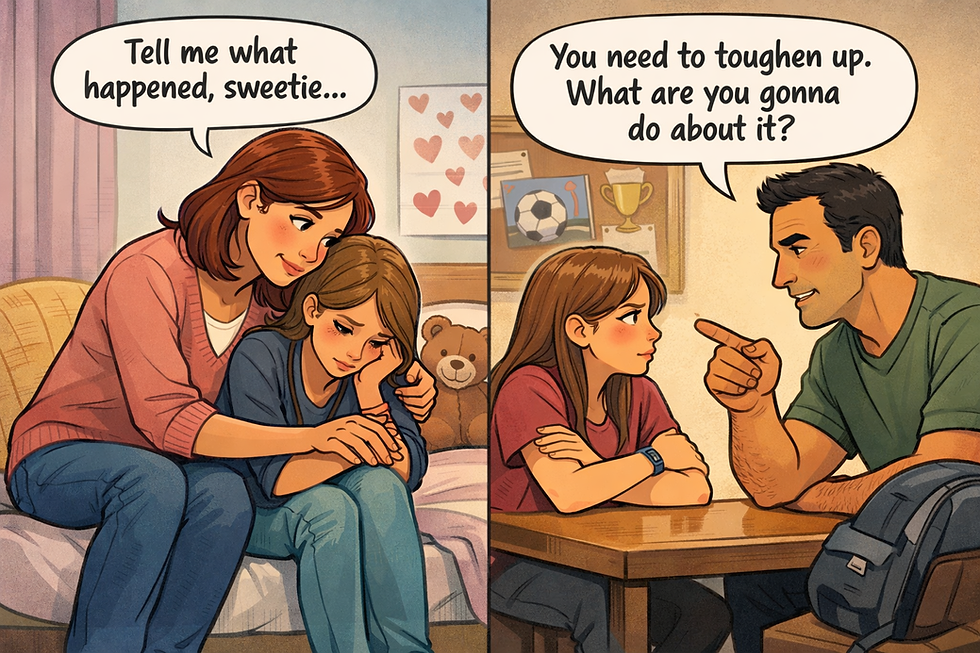
Conflict is where things really diverge. If a child comes home upset after a fight with a friend, a mother is likely to sit down, unpack the entire emotional situation, and possibly revisit it later just to make sure everyone is still okay. A father might listen, nod, and then say, “So what are you going to do about it?” Both parents are concerned, but Dad sees the situation as an opportunity to help his child develop concrete problem-solving skills.
When it comes to involvement, mothers are often deeply entrenched in the details, homework, schedules, social dynamics, the name of every friend, that friend’s mother, and possibly the friend’s dog. Fathers may not know the name of the math teacher, but they want to attack the broader picture, and suddenly they’re giving a full lecture on “how the real world works” at 9:30 p.m. on a Tuesday.
Communication styles are equally distinct. Mothers ask questions. Lots of them. “How was your day?” “What happened?” “How did that make you feel?” Fathers ask fewer questions, ultimately asking their child if everything is good. And if the child says yes, that’s the end of it. Case closed.
Teenage years bring these differences into sharp focus. Mothers may want to hold on just a little longer, worried about every decision, every friend, every late night. Fathers are more likely to lean into independence: “They’ll figure it out.” One parent anxiously waits for the sound of their child coming home, while the other watches TV, completely unbothered.
You’d think that once the kids are all grown up, parenting would be easier. But as my father used to say, when your kids are small, the problems are little, but when they get big, so do the problems. Mothers really feel frustrated because now they might see their child suffering, but there’s not much they can do about it. Meanwhile, fathers resort to the adage that now they’re grown and need to lead their own lives.
Of course, a lot of this comes down to how men and women have been conditioned to parent. Society has long encouraged women to be the emotional, nurturing center and men to be the steady, practical force. But the lines are blurring. There are fathers who know every emotional nuance and mothers who say, “You’ll survive, go handle it.” Parenting styles are evolving, even if the stereotypes still linger.
In the end, the differences in parenting might be just what a child needs. Kids benefit from having someone who listens to every detail and someone who reminds them they’ll be okay. And somewhere between “Let’s talk about your feelings” and “Walk it off,” children learn how to navigate the world, with both heart and resilience.

Comments