

Friendship-Two Very Different Versions

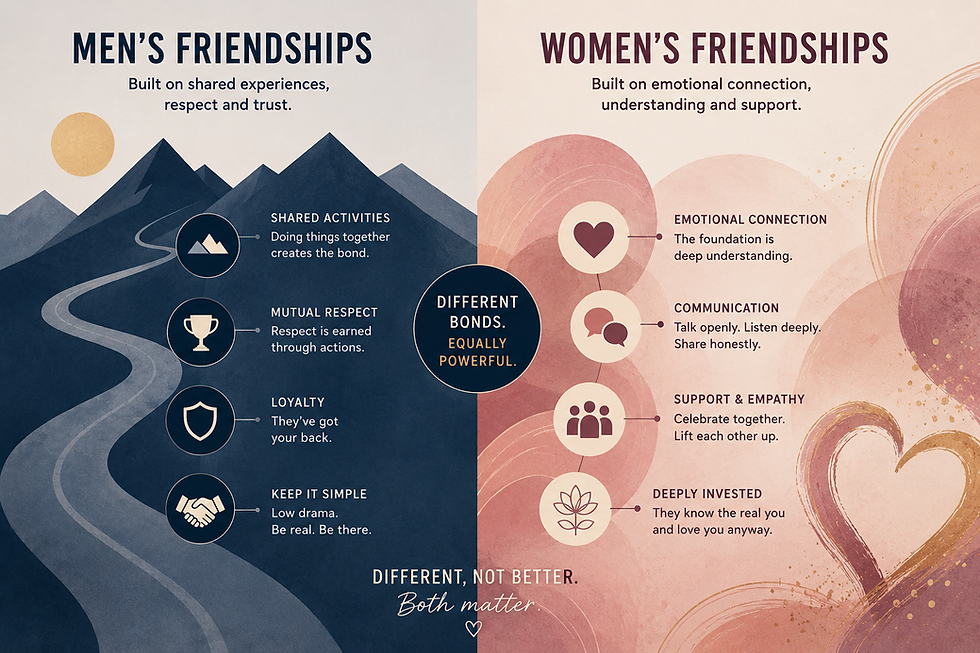
Men and women both claim to value friendship equally, but if aliens landed on Earth and studied how each gender actually behaves with friends, they would assume they were observing two entirely different species. Women often maintain friendships with emotional detail, layered communication, and the ability to discuss a disagreement from 2007 with forensic precision. Men, meanwhile, can go six years without speaking to a friend, randomly text “You alive?” and immediately resume the relationship as though no time has passed at all. Neither approach is wrong. One is simply emotionally intricate. The other resembles wildlife migration patterns.
Women’s friendships often function like an emotional support network mixed with a detective agency. A female friend can detect sadness from the punctuation in a text message. If another woman responds with “Fine.” instead of “Fine!”, alarms begin sounding across three counties. Within minutes, someone is analyzing screenshots, someone else is bringing coffee, and another friend is preparing a full emotional timeline dating back to Labor Day weekend. Men, on the other hand, can sit beside their best friend for three hours watching football without exchanging a single meaningful sentence and still leave saying, “Great talk today.”
Then there is the issue of communication frequency. Women often communicate continuously. There are text chains, side text chains, emergency side text chains, and “Don’t mention this in the other group” text chains. Men, however, treat communication like checking smoke detectors: only necessary a few times a year. A man can disappear into silence for eight months, then suddenly send his friend a blurry photo of a lawnmower with the message: “This thing’s a beast.” That is apparently enough to maintain a lifelong emotional bond.
Women also tend to remember personal details with astonishing accuracy. One woman can remember her friend’s dentist appointment, anniversary problems, child’s allergy, and the exact name of the waiter who ruined brunch in 2019. Men usually remember only the essential categories: “divorced guy,” “boat guy,” “fantasy football guy,” and “friend who almost got arrested in Tampa.” Entire male friendships are often sustained entirely by one shared story involving poor judgment and barbecue.
Conflict resolution between the genders deserves its own sociology course. Women may analyze a disagreement carefully, discuss feelings, revisit context, and seek emotional clarity. Men often resolve conflict through a method best described as “pretending it never happened.” Two male friends can have a screaming argument over golf, not speak for two weeks, then suddenly reunite over chicken wings as if history has been erased. No apology. No processing. Just, “You wanna grab a beer?” Somehow this works.
Vacation behavior reveals even more differences. Women traveling together often plan itineraries, make restaurant reservations, coordinate outfits, pack backup chargers, and bring enough sunscreen to survive nuclear winter. Men planning a trip frequently operate with one sentence: “We’ll figure it out.” This is how four grown men end up sharing one hotel room with no towels, no toothpaste, and a folding chair being used as a nightstand. Yet somehow they describe the weekend as “legendary.”
Another fascinating distinction is how each gender handles emotional vulnerability. Women frequently discuss fears, insecurities, relationships, and stress in depth. Men often communicate emotion through bizarre, indirect methods. One man may spend six hours helping another man move a refrigerator down three flights of stairs instead of simply saying, “I care about you.” In male friendship culture, physical labor is apparently considered an acceptable substitute for emotional disclosure.
In the end, both men and women build friendships rooted in loyalty, trust, and connection; they just travel very different roads to get there. Women may process friendship through conversation, empathy, and emotional detail. Men may process friendship through shared experiences, sarcasm, and helping someone install a television mount without reading the instructions. But whether it’s a three-hour phone call dissecting feelings or two men silently fishing while occasionally grunting, friendship somehow works beautifully in both worlds, even if one world definitely has far more group texts.



Comments