

The Great Sick-Day Divide

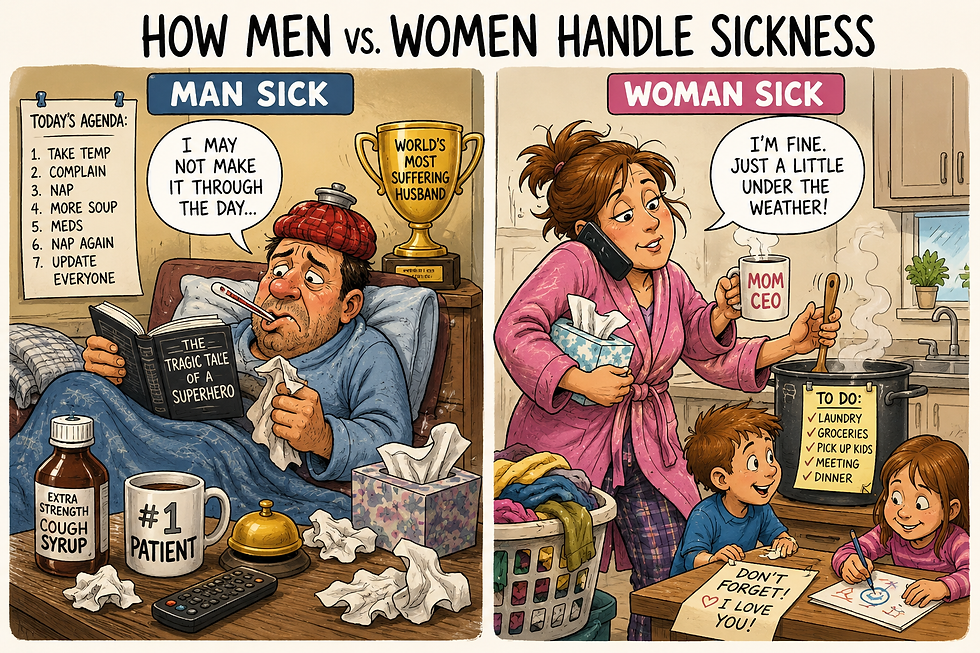
Every family eventually witnesses one of nature’s most fascinating phenomena: the difference between how men and women react when they get sick. Scientists may never fully understand it, but countless spouses have observed the pattern with remarkable consistency. The common cold, for example, can produce dramatically different responses depending on who catches it.
When a woman wakes up with a sore throat, congestion, and a fever, her first thought is often, “I don’t feel great, but I still have things to do.” She makes breakfast, answers emails, walks the dog, and perhaps even drives someone to an appointment before finally admitting that she might need a little rest. Somewhere around dinner time, she casually mentions, “I think I’m coming down with something.”
A man, on the other hand, may awaken with a single sneeze and immediately begin assessing his life expectancy. He stares solemnly into the distance and announces, “I think it’s serious.” Within minutes, he has relocated to the couch, gathered blankets, and begun preparing what appears to be a final statement for loved ones. The family is advised to carry on without him.
Women tend to become highly efficient patients. They take their temperature, locate the appropriate medication, drink fluids, and continue functioning. They often maintain detailed records of symptoms, treatment schedules, and hydration levels. By contrast, many men become medical detectives. Every cough requires research. Every ache requires analysis. A slight headache can trigger an internet search that somehow ends with a diagnosis involving a rare tropical disease.
The communication styles differ as well. A woman may mention being sick only when someone notices she sounds hoarse or looks exhausted. Men frequently provide hourly updates. Family members receive regular bulletins on congestion levels, energy levels, and the exact degree of discomfort experienced. Charts and graphs may not be far behind.
Then there is the issue of sympathy. Women often continue caring for everyone else while sick themselves. Men, however, may view illness as a team sport requiring active audience participation. They appreciate frequent check-ins, reassuring comments, and perhaps a ceremonial delivery of soup. The phrase “How are you feeling?” can be repeated every twenty minutes without becoming excessive.
Of course, there are exceptions. Some men soldier through illness without complaint, and some women become wonderfully dramatic patients. But stereotypes persist because so many people recognize a grain of truth in them. Entire marriages have been built upon one partner rolling their eyes while the other claims to be fighting for survival against a mild head cold.
In the end, both approaches have their merits. Women remind us of the power of resilience. Men remind us that sometimes it’s okay to slow down, rest, and let others take care of us. And whether you’re the stoic sufferer or the self-declared medical emergency, one thing is certain: every household has its own version of the Great Sick-Day Divide, and it provides almost as much entertainment as the illness itself.
And don’t even get me started on the ensuing drama that follows a broken leg.



Comments